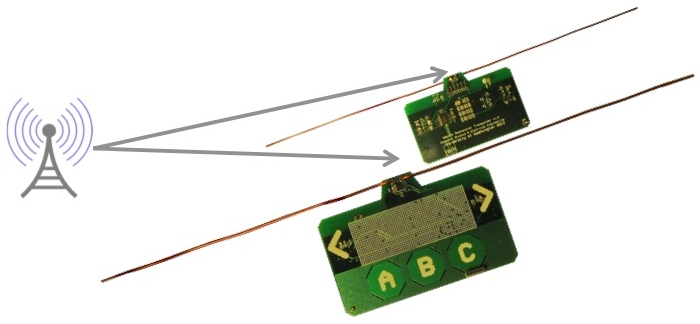
Where does the energy come from?
A transmitting station supplies radio-frequency energy. A receiving antenna couples to a small part of the field; a rectifier converts suitable incoming RF into DC. Storage and power-management circuits can accumulate that energy for intermittent use. The transmitter still consumes energy elsewhere in the system. [1]
- BroadcastExternal energy
- AntennaReceived RF
- RectifierConverted DC
- Storage + loadUseful work
Ambient harvesting uses an existing signal. Dedicated wireless power installs or operates a transmitter to supply the device. Both can be legitimate engineering, but they have different energy and infrastructure costs. Backscatter is a communication technique: it encodes information by changing reflections of an existing signal rather than generating a conventional new carrier. [2]
Three studies, three different outcomes
| Research | Reported result | What it does not show |
|---|---|---|
| Piñuela et al., 2013 [1] | Survey outside 270 London Underground stations. First GSM900 prototype: 40% end-to-end efficiency under the reported test conditions; about half the surveyed locations suitable for the four prototypes. | 40% of all radio energy in a city, or a guaranteed output today at a different site. |
| Liu et al., 2013 [2] | Battery-free backscatter communication at 1 kbps over 2.5 feet outdoors and 1.5 feet indoors in the reported tests. | Those are communication distances between prototype devices, not household power delivery distances. |
| UW battery-free phone, 2017 [3] | 3.5 µW prototype budget. RF-powered operation up to 31 feet from a custom base station; a separate light-powered case communicated at 50 feet. | Charging or fully operating an ordinary smartphone from arbitrary background Wi-Fi. |
These are selected, well-documented examples, not a ranking of the newest or best devices. Their value is the inspectable experimental boundary. Old RF surveys cannot establish what is available at your location after network, building, and spectrum changes.
A conversion efficiency is a fraction, not a power rating. Forty percent of a small received input remains a small output. Likewise, a low-power device succeeding in one demonstration does not mean a much larger load will work if connected to the same harvester.
Put the power scale in numbers
At an assumed -20 dBm rectifier input, received RF power is 10 µW. With an assumed 30% conversion efficiency, DC output is 3 µW. Sustained for 24 hours, that is 0.000072 Wh. These are arithmetic assumptions, not measurements from the studies above.
Conditional RF power budget
- RF input
- 10 µW
- Converted DC
- 3 µW
- Energy in 24 hours
- 0.000072 Wh
Below the assumed average load. DC output is 30% of the load.
Assumption model only. Input is power available at the rectifier, not transmitter output or field strength. Efficiency is user-supplied, not predicted. Startup thresholds, signal variation, storage leakage, and downstream losses can prevent operation even when the average budget appears sufficient.
PRF (µW) = 1000 × 10dBm/10; PDC = PRF × efficiency / 100.
Why storage helps, but does not multiply energy
A sensor can sleep while a capacitor charges, then spend stored energy on a short measurement. The long-run average demand must still fit within the harvested budget. A larger capacitor changes timing; it does not increase the average energy arriving at the antenna.
For scale, 1 watt is 1,000,000 µW. At a constant 10 µW of usable output, collecting 1 Wh would take 100,000 hours before storage losses. A claimed phone or household supply should therefore show actual loaded watts and operating duration, not just a voltage appearing on a meter.
What should a credible measurement include?
- Frequency band, location, antenna geometry, orientation, and the time of the observation.
- RF input at a specified reference plane and DC output into a known load.
- Instrument calibration, bandwidth, uncertainty, and whether measuring changes the load.
- Cold-start behavior and time required to accumulate useful energy.
- External supplies, USB connections, stored charge, and illumination.
- Source-off or appropriately shielded controls, repeated trials, and raw data.
Do not confuse open-circuit voltage with usable power. Test under a specified load and account for precharged storage. If USB powers a development board during a demonstration, that power must be included. This checklist is editorial guidance for documenting a test, not a laboratory result.
Use passive, low-energy educational setups under qualified supervision. Do not approach transmission equipment, attach to utility structures, build elevated outdoor collectors, or increase RF exposure to improve a result. Consider the safety and operating requirements of any equipment used.
Watch the battery-free phone demonstration
The University of Washington links this demonstration from its 2017 report. Watch it as a prototype demonstration, not a substitute for the study conditions. [3]
Watch on YouTube · Read the university's account
Playback availability varies by region and browser. The source article remains available if the embedded player cannot load.
Sources and reading limits
These references support the specific claims marked above. A publication, patent, demonstration, and independently replicated result are different kinds of evidence.
- Piñuela, Mitcheson & Lucyszyn (2013): Ambient RF Energy Harvesting in Urban and Semi-Urban Environments
IEEE Transactions on Microwave Theory and Techniques 61, 2715–2726; DOI 10.1109/TMTT.2013.2262687. Original survey and prototype study; historical locations and network conditions, not a current universal power forecast.
- Liu et al. (2013): Ambient Backscatter: Wireless Communication Out of Thin Air
SIGCOMM 2013 original research paper. Reported ranges concern device-to-device communication; do not confuse them with distance to the broadcast tower.
- University of Washington (2017): Battery-free cellphone demonstration
Institutional report and linked demonstration of the team's prototype. Describes a custom base station and separate RF-powered and light-powered cases, not a conventional smartphone charger.
For classification and correction standards, read how we evaluate evidence.