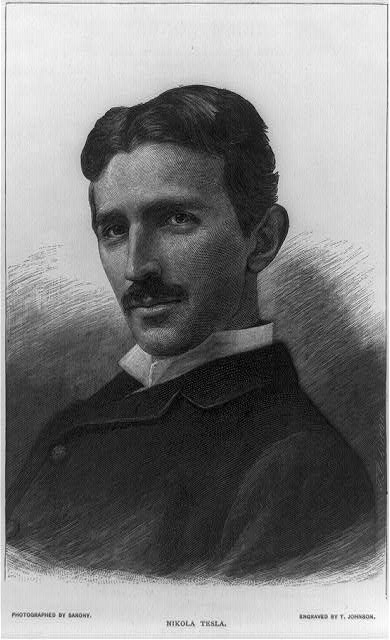
Who was Nikola Tesla?
Nikola Tesla was a Serbian-American inventor and electrical engineer whose work connects the history of electric motors, high-frequency circuits and wireless control.[2] His story is not just about spectacular sparks. It is about finding useful ways to turn electrical effects into machines.
- Born
- July 10, 1856 · Smiljan
- Died
- January 7, 1943 · New York
- Known for
- Polyphase motors, high-frequency experiments and wireless control
From Smiljan to New York
Raised in a Serbian family, Tesla credited his mother's inventiveness as an influence. He studied in Graz but did not graduate. Work in Budapest and Paris preceded his arrival in New York in 1884. His employment with Edison was brief; the important next chapter was building a career around his own electrical ideas.[1]
The familiar Tesla-versus-Edison story is a useful doorway, not the whole biography. To understand an invention, look beyond the rivalry: what problem did the apparatus solve, what did its patent actually claim, and what other people and infrastructure made deployment possible?
What did Nikola Tesla invent?
The AC motor and rotating magnetic field
Tesla's 1888 motor patent explains how currents in separate circuits can progressively shift a magnetic field and produce rotation. Its drawings connect a generator, circuits and a motor: an electrical system, not an isolated miracle component. The practical idea is powerful: a changing magnetic field can make a rotor follow it.[3]
Westinghouse acquired rights to Tesla's AC inventions in 1888.[1] At Niagara, the broader achievement required water power, generators, transmission equipment and engineering teams. The National Park Service records delivery of Niagara electricity to Buffalo in 1896 using the Westinghouse-Tesla system.[4] Tesla helped advance the use of electricity; he did not invent electricity itself.
The Tesla coil and high-frequency electricity
The coil is the dramatic public image of his work, but the circuitry is the real story. His 1891 lighting patent describes producing very rapid electrical oscillations and using an induction coil to obtain high potentials. It links an electrical source, a capacitor discharge and coupled coils with lighting experiments.[5] High voltage is not the same as high energy output, and a spectacular arc is not an efficiency measurement. These are dangerous high-voltage systems, not safe home experiments.
Wireless control of moving machines
Tesla's 1898 patent concerns controlling vessels or vehicles at a distance. It describes a receiver and mechanisms for carrying out commands, making it a valuable early document in the history of remote control.[6] Notice the distinction between sending a control signal and supplying propulsion energy: controlling a machine wirelessly does not mean its motor receives unlimited wireless power.
Colorado Springs and the Wardenclyffe dream
In 1899 Tesla pursued high-voltage and wireless investigations in Colorado Springs.[1] His next great project was Wardenclyffe, where construction began in 1901. The Long Island facility combined a laboratory with a 187-foot tower. Tesla envisioned worldwide communication and wireless power transmission, with personal receivers carrying speech and information across distance.[7]
That ambition deserves serious attention without treating a proposed system as a completed one. Sending energy somewhere and creating energy are different problems. Wardenclyffe is not evidence of a working generator that produced energy from nothing. Our Wardenclyffe research guide follows the distinction between the historical project, wireless delivery and modern free-energy claims.
Nikola Tesla timeline
- 1856
Born in Smiljan
July 10, in the Austrian Empire, in present-day Croatia.[1]
- 1884
Arrives in America
Works briefly for Edison before pursuing his own projects.[1]
- 1888
Motor patent granted
US 381,968 describes a motor driven by shifting magnetic fields.[3]
- 1891
High-frequency lighting
US 454,622 documents high-frequency, high-voltage circuitry.[5]
- 1896
Niagara reaches Buffalo
Hydroelectric power is transmitted roughly 26 miles to the city.[4]
- 1898
Remote-control patent
US 613,809 describes controlling moving vessels or vehicles.[6]
- 1899
Colorado Springs
Investigates high-voltage electricity and wireless transmission.[1]
- 1901
Wardenclyffe begins
Construction starts on a laboratory and wireless tower on Long Island.[7]
- 1943
Dies in New York
January 7, aged 86.[1]
Why Tesla still matters
Tesla died in New York in 1943. In 1960, his name became the name of the SI unit of magnetic flux density.[1] His legacy offers something more durable than a ranking of inventors: an invitation to study how imagination becomes an apparatus, how an apparatus becomes a system, and why some ambitious systems never succeed.
For this club, admiring Tesla means reading the record closely. His achievements are extraordinary without attaching every later energy claim to his name. Start with a patent, trace the circuit, ask what powers it, and distinguish the inventor's expectations from demonstrated results.
Was Nikola Tesla Serbian or Croatian?
His family background was Serbian; his birthplace, Smiljan, is in present-day Croatia. He is described as Serbian-American in the Science Museum Group's record.[1][2] Birthplace, ethnicity and citizenship are different descriptions, not competing answers.
Did Tesla invent free energy?
The patents and historical sources cited here do not establish a device producing net energy from nothing. They document motors, electrical circuits, remote control and ambitious transmission projects. Explore the Energy Cost Lab for the difference between energy generation, storage, harvesting and unsupported over-unity claims.
Where should I start reading his work?
Begin with the three patents below. Read the diagrams and specification together, rather than relying on the title or a viral quotation. Then visit our historical archive and people directory for context. A patent records a claimed invention; it does not independently validate every performance claim.
Sources and further reading
AI-assisted editorial synthesis of public historical and primary sources, checked September 19, 2026. This is an introduction, not a complete archival biography. Read our evidence and correction standards.
- Tesla Science Center: About Nikola Tesla
Biographical chronology, early life, collaborators and later years.
- Science Museum Group: Nikola Tesla
Museum authority record for his identity and occupations.
- US 381,968: Electro-magnetic motor (1888)
Primary source: rotating magnetic fields, coils and motor arrangements.
- National Park Service: Origins of Hydroelectric Power
Historical context for Niagara and transmission to Buffalo in 1896.
- US 454,622: System of Electric Lighting (1891)
Primary source: high-frequency currents, capacitive discharge and induction coils.
- US 613,809: Controlling Moving Vessels or Vehicles (1898)
Primary source: remotely operated mechanisms and control apparatus.
- Tesla Science Center: History of Wardenclyffe
The laboratory, tower and proposed global wireless system.
- Library of Congress: Tesla portrait, LC-USZ62-61761
Wood engraving by T. Johnson after a Sarony photograph. Cataloged circa 1906; no known publication restrictions. Catalog dating is not a confirmed photographic sitting date.